
RESEARCH LAB
Living Lab
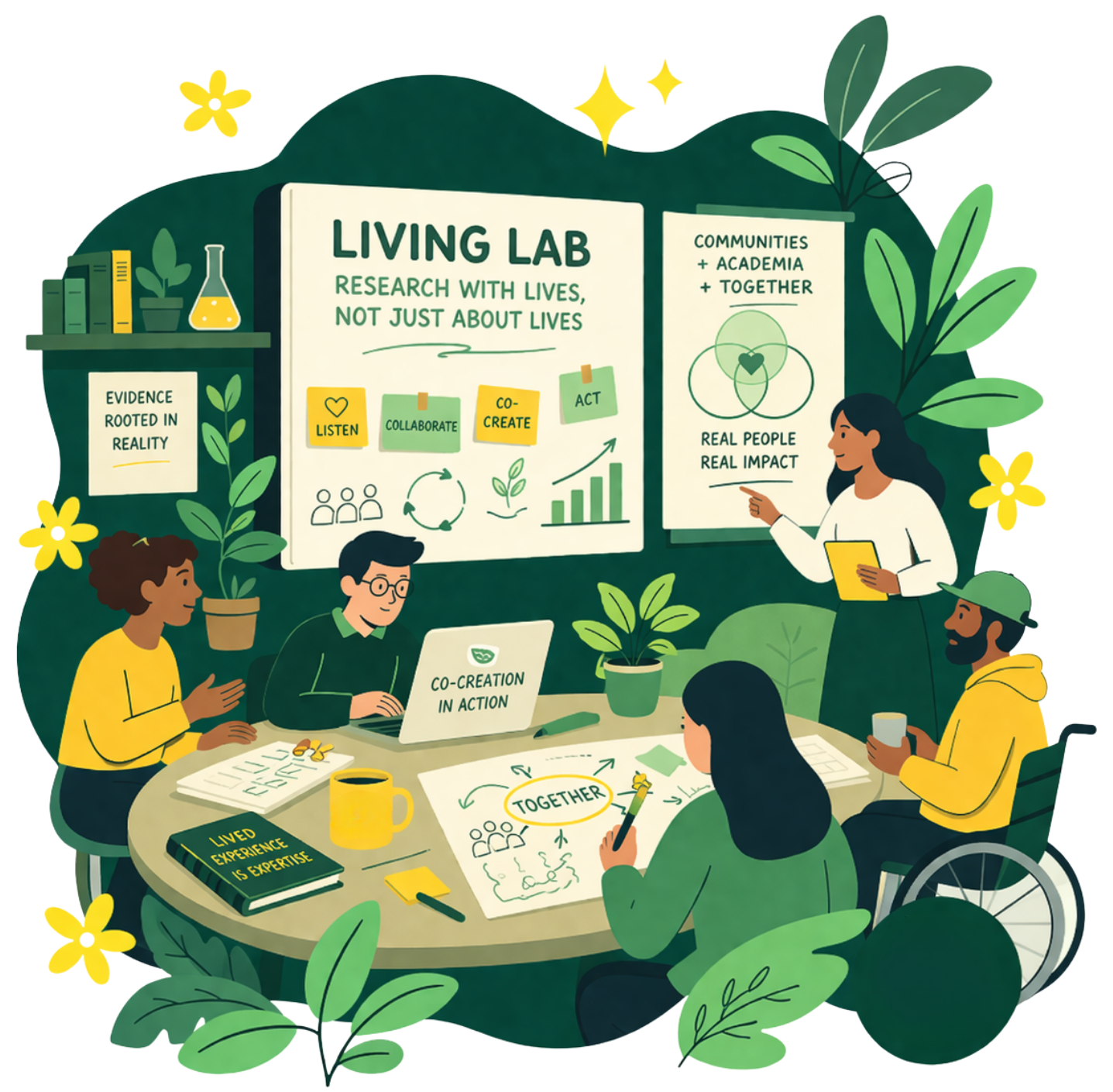
At Unmasking Collective, we believe lived experience research is essential to understanding mental health beyond clinical walls. Too often, research happens in academic “ivory towers,” disconnected from the realities it claims to represent. Lives are reduced to data points, stripped of context, and filtered through someone else’s lens. While academic research has its strengths, it can miss the nuance, humanity, and social contexts that shape lived realities.
By centering lived experiences, we aim to unmask research moving from studying people as subjects to collaborating with them as co-creators of knowledge. This approach values the wisdom gained through living, surviving, and thriving in specific contexts, treating it as expertise equal to formal qualifications.
Lived experience research bridges the gap between communities and academia. It ensures that knowledge is:
- Grounded in reality, not removed from it.
- Responsive to community needs, not just academic agendas. Research beyond academia!
- Inclusive and accountable to the people it represents.
This is our commitment: to make research not just about lives, but with lives - ensuring that the voices at the margins are at the centre of the conversation.
MEET THE TEAM
Research Leads
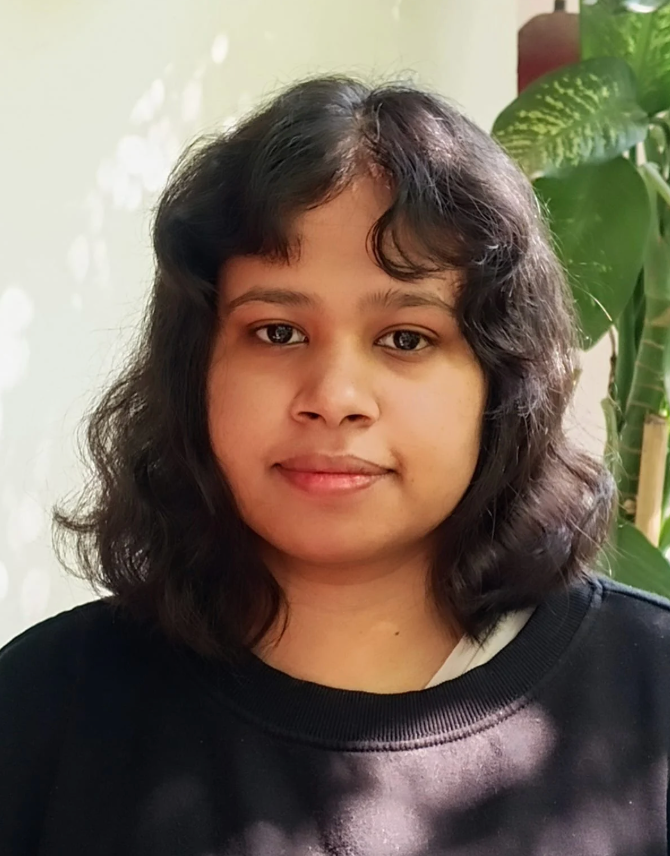
Atreyee Sikdar (she/they)
Pursuing Ph.D. in Psychology, University of Delhi
M.A. in Psychosocial Clinical Studies, Ambedkar University Delhi
B.A. (Honours) in Psychology, University of Delhi
Atreyee’s lens as a researcher is kaleidoscopic. She borrows from psychoanalysis, psychological anthropology, critical theory, cultural studies, and interdisciplinary art. She is a doctoral fellow at the University of Delhi. Through her fellowship, she aims to document the experiences of community mental health workers in India using qualitative methods for postulating an indigenised perspective on care-work. In the past, she has received scholarships from the School of Human Studies at Ambedkar University Delhi as well as Kakar Centre for Psychoanalysis and Culture to support her postgraduate training. In her side-quest as the co-founder of Living Lab, Atreyee leads projects that search for enclaves of health, wellbeing, and care, outside the clinic. In these searches, alongside her team, she heeds to postcolonial subjectivities and epistemic marginalities when reckoning with issues of mental healthcare. Through this approach she finds ways in which communities can be empowered with agency and not exhausted as a resource when universalising the right to mental health.
Areas of Interest: Local in Global Mental Health; Psychosocial Residues of Care Labour; Rhizomorphic Care Models; Out-of-Clinic Possibilities and Pathways of Support; Relations of Self with Material and Internal Objects; Experiences of Self in Polycrisis.
Preferred Methods: Psychohistory; Case Study; Patchwork Ethnography; Sensory Ethnography; Autotheory; Literary Criticism; Diary-based Inquiries for Experience Sampling; Arts-based Inquiries for Testimonial and Hermeneutic Justice; Qualitative Methods for Programme Design and Evaluation.

Shriya Gaur (she/they)
M.A. Clinical Psychology
Teachers College, Columbia University
Shriya is the Founding Research Lead of the Living Lab at Unmasking Collective. Her work is grounded in a sustained engagement with lived experience - particularly the ways individuals narrate, negotiate, and make meaning of identity within complex social and cultural contexts. At the Living Lab, Shriya leads qualitative research initiatives that prioritize careful listening, ethical reflexivity, and methodological rigor. She is committed to building research spaces where marginalized voices are not treated as data points, but as knowledge-bearing narratives shaped by power, culture, and history. Their practice bridges clinical sensitivity and research discipline, with particular attention to how heteronormativity, stigma, and institutional norms shape self-understanding. Across projects, she centers personhood over pathology and complexity over simplification, ensuring that inquiry remains accountable to the communities it seeks to represent. Through her leadership, the Living Lab advances research that is both analytically rigorous and attentive to the emotional and relational dimensions of lived realities.
Areas of Interest: LGBTQIA+ lived experiences in South Asian contexts, Sexuality and identity negotiation, Gender dysphoria and self-identity formation, Reproductive identity and narrative meaning-making, Heteronormativity and sociocultural barriers, Queer mental health and personhood, Community-based and socially accountable research, Cross-cultural experiences.
Preferred Methods: In-depth semi-structured interviews, Narrative inquiry, Thematic analysis, Reflexive qualitative research, Autoethnographic approaches, Mixed-method designs (qualitative-led), Community-engaged research practices
Projects Under Pipeline
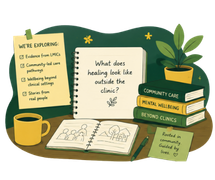
For Healing to be Legitimate,
It Needn’t be Hospitalised
September 2025 to September 2026 (Proposed)
First-ever review of evidence from low-and-middle-income countries to scope the potential of third places, as a viable community-based pathway towards better mental health.